


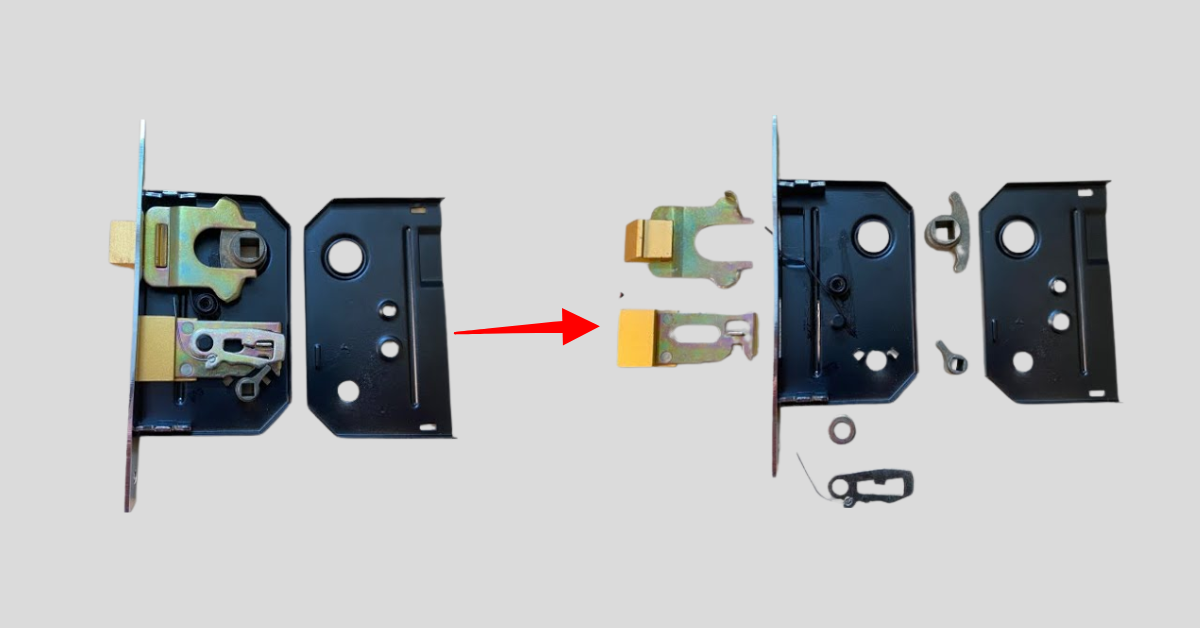
How does a door lock mechanism work: 7 easy steps start with a simple idea, the key aligns internal pins at the shear line, the cylinder plug turns, and a cam retracts the latch or throws the deadbolt so the door opens. If your key turns but the door will not open, or the lock works when open but not when closed, this guide will help you understand what is happening inside the mechanism.
At Kingdom Locksmith in Coventry and across the UK, we explain it like this. Most locks are a pin tumbler lock or euro cylinder system. Your key lifts key pins and driver pins until they line up at the shear line. That lets the cylinder plug rotate. The plug turns a cam or tailpiece, which retracts the latch bolt or throws the deadbolt.
The 7 Easy Steps From Key To Open The Door:
- The key enters the cylinder and slides under spring-loaded pins.
- Pins rise to the shear line, so nothing blocks the plug.
- The cylinder plug rotates when you turn the key.
- Cam or tailpiece engages and converts rotation into movement.
- Latch bolt retracts (or the deadbolt extends or retracts), depending on the lock type.
- Strike plate and keep guiding the latch into the frame as the door closes, alignment is crucial for smooth locking.
- Springs reset the pins when you remove the key, locking the plug again.
This is the core answer to “how a door lock works”, the key aligns pins, the plug turns, the cam moves the latch or bolt.
Door Lock Mechanism Definition: The Parts And What They Do
When we explain this on a callout in Coventry, we usually say, “A lock is just a chain of tiny parts passing movement along.” If one link slips, you feel it as a stiff key, a floppy handle, or a door that only locks when it is half open. At Kingdom Locksmith, We use the same simple model to diagnose faults fast, whether it is a euro cylinder on a uPVC door or a mortice lock in a timber door.
Cylinder, Plug, Pins, Springs,
Most everyday door locks in the UK are based on a pin tumbler lock inside a cylinder. Here is what is moving when you insert and turn the key: The cylinder is the outer body. Inside it sits the plug (sometimes called the cylinder plug), which is the part your key turns. Above the plug are stacks of key pins and driver pins, pushed down by springs. With no key inserted, the pins straddle the boundary between the plug and the cylinder body, stopping the plug from rotating. With the correct key, the pins align at the shear line, and the plug can rotate.
Cam Or Tailpiece
Once the plug rotates, it still has to move the door’s locking parts. That is the job of the cam or tailpiece. On many euro cylinders, the cam is the rotating piece at the back of the cylinder that transfers the plug’s turn into the door’s lock mechanism. In plain terms, it converts key rotation into the action that retracts a latch or throws a bolt. This is also why you can sometimes get the symptom “the key turns but nothing happens.” The plug may rotate, but the cam, tailpiece, or connection to the lock body may not be engaging properly.
Latch Bolt Vs Deadbolt
These two parts look similar from the door edge, but they behave differently. A latch bolt is usually spring-loaded. It retracts when you press the handle and it “snaps” back out when the door closes, guided by the strike plate. A deadbolt is not spring-loaded, it is designed for security, and it moves only when you turn a key or thumbturn to throw it into the frame.
Strike Plate And Keep
The lock does not “finish” its work inside the door. It has to land cleanly in the frame. The strike plate (often called the keep in UK hardware talk) is the metal plate on the frame that receives the latch or bolt. If the keep is even a few millimetres high, low, in, or out, you get classic symptoms like “works open, not closed,” scraping, stiff turning, or a door that needs lifting to lock. That alignment issue is especially common on uPVC and composite doors, where the mechanism keeps lining up across the frame.
The 7-Step Mechanism Walkthrough: Step-By-Step Motion Inside The Lock
When we explain this at a Coventry callout, we usually hold the key up and say, “This tiny bit of metal is only doing two jobs. It lines the pins up, then it turns the plug.” Everything else, the cam, latch, deadbolt, strike plate, is just movement being passed along. Once you see that chain, you can understand why a lock can feel smooth one day and then start sticking the next.
Step 1: Key Cuts Align Pins At The Shear Line
Inside a pin tumbler lock, the key lifts key pins and driver pins against springs. With the correct key, the split between the pins lines up at the shear line (also called the shear point). That clears the plug to turn.
Step 2: Plug Rotation Begins, Why Friction Matters
Once the shear line is clear, the cylinder plug can rotate. Friction is the reason a “working” key can still feel stiff. Dust, worn keys, dry pins, or slight cylinder wear can make the plug drag instead of turning cleanly. In plain terms, the pins line up, but the plug still has to move freely.
Step 3: Cam Engages, Latch Retracts, Bolt Throws
At the back of the plug is a cam or tailpiece. As the plug turns, the cam transfers that rotation into the door’s locking action, retracting a latch or moving a bolt, depending on the mechanism. This is why euro cylinders are so common, the cylinder can be changed without changing the whole lock body.
Step 4: Handle Spindle And Follower, How Handles Retract The Latch
Handles work through a spindle. When you push the lever down, the spindle rotates inside the lock’s follower (the square drive hole), and that retracts the latch bolt. This is also where looseness shows up first. A worn follower or the wrong spindle length can make the handle feel sloppy even if the cylinder is fine.
Step 5: Door Closes, Latch Bevel And Strike Guide The Lock-In
When you close the door, the angled face of the latch bolt rides against the strike plate and compresses, then springs back out into the keep. If the strike plate is slightly out of line, the latch can catch, scrape, or fail to seat fully, and people often blame the lock instead of the alignment.
Step 6: Locking Action, Deadbolt, Thumbturn, Key Differences
A latch bolt is spring-loaded and mainly holds the door shut. A deadbolt is a stronger bolt that only moves when you turn a key or thumbturn. In many UK setups, the handle retracts the latch, while the key or thumbturn throws the deadbolt for security or privacy.
Step 7: Unlock Cycle, What Resets And Why It Can Bind
When you turn back to unlock, the cam reverses the motion, the latch or bolt retracts, and when you remove the key the springs push the pins back down so the plug cannot rotate again. Binding usually appears here when alignment is forcing the bolt sideways, or when the plug is turning but the cam is struggling to move the lock body under load.
At Kingdom Locksmith, We use this exact 7-step chain on site in Coventry and across the UK. It helps us decide quickly whether the fault is inside the cylinder, in the lock body, or simply at the strike plate and keep alignment, then fix it properly with the least disruption.
Mechanism Types In Uk Homes
When we arrive at a Coventry job, the first thing we do is not pick up tools. We look at the door edge, the handle, and the keyway. In the UK, that quick look usually tells you which door lock mechanism you have and how it is supposed to move. At Kingdom Locksmith, we use this to diagnose fast because each mechanism fails in a slightly different way.
Euro Cylinder
If you have a uPVC door or composite door with a long handle, you will often have a euro cylinder. Inside, it is typically a pin tumbler design, and the key turns the cylinder plug. That rotation moves a cam on the back of the cylinder, which operates the door’s lock case or the multipoint locking strip gearbox.
Mortice Sash Lock
A mortice sash lock is common on timber doors where you want a handle for everyday use and a key for security. The lock case contains a spring latch (operated by the handle spindle and follower) plus a deadbolt (thrown by the key). Think of it as “two jobs in one case”, latch for closing, bolt for locking.
Mortice Deadlock
A mortice deadlock is the simplest security-first option on timber doors. It has no spring latch, just a solid bolt that throws into the frame when you turn the key. Because there is no latch action, it is strong and straightforward.
Nightlatch
A nightlatch is surface-mounted on the inside of a door and is opened from outside with a key and from inside with a knob. The feature most people forget about is the snib, a small button or slider that can hold the latch back or deadlock it, depending on the model. If the snib is damaged, lockouts become more likely.
Tubular Latch
A tubular latch is the common internal door latch for bedrooms, kitchens, and many bathrooms when privacy is handled by separate furniture. It is morticed into the door edge and acts as a sprung catch. When you press the handle, the spindle rotates and retracts the latch.
Upvc Multipoint Lock Mechanism: How It Works And Why It Fails
We still hear the same line on Coventry callouts, “The handle lifts fine when the door is open, but the moment I close it, it fights me.” In most cases the mechanism is not “mysteriously broken.” The uPVC multipoint system is doing exactly what it is designed to do, it refuses to lock smoothly if the locking points cannot line up with the frame.
At Kingdom Locksmith in Coventry and across the UK, We treat uPVC multipoint faults as a mix of mechanics and alignment. Once you understand the moving parts, you can tell the difference between a quick adjustment and a gearbox that is genuinely failing.
Gearbox, Hooks, Rollers, Keeps, How The Strip Locks The Frame
A uPVC multipoint lock is a long strip running up the door edge. The gearbox in the middle is the “engine.” When you lift the handle or turn the key, the gearbox drives the locking points along the strip, often hooks, rollers, or bolts, into the keeps on the frame. Here is the simple chain of motion:
- You lift the handle, the gearbox engages.
- The strip moves, hooks or rollers travel toward their keeps.
- When everything lines up, the key turn finalises the lock, depending on the design.
Handle Lift Action: Why It Feels Stiff When Alignment Is Off
Handle lift relies on smooth engagement between locking points and the frame keeps. If the door has dropped slightly, or the keeps are a couple of millimetres out, the hooks and rollers hit metal instead of sliding into place. The gearbox then has to fight that resistance, and you feel it as a heavy handle. Common UK causes of that misalignment include:
- Seasonal movement, temperature changes can affect how the door sits in the frame.
- A dropped door or hinge movement, the door sits slightly low or twisted.
- Keeps that have shifted over time, sometimes after repeated force on the handle.
“Locks When Open, Not When Closed”
This one test solves a lot of confusion quickly.If your uPVC door lock works when open but will not lock when closed, it very often points to a misaligned door or keeps. Trade answers repeatedly highlight checking rub marks on the keeps and aligning them with the locking points. Try this safe check:
- With the door open, lift the handle and turn the key gently. If it feels normal, the gearbox is probably capable of working.
- Close the door slowly, then lift the handle. If it becomes stiff or stops, look for rub marks on the frame where hooks or rollers are catching.
When The Gearbox Is Failing, Symptoms You Should Not Ignore
Sometimes alignment is not the full story. The gearbox is the most used part of the system, and it can be worn. Locksmith training guidance describes the gearbox as the central component that converts handle and key movement into action at hooks, rollers, or bolts, and it is often the costliest part to replace. Red flags that point to real mechanism wear, not just keeps:
- Grinding, crunching, or a “slip” feeling inside the door when you lift the handle.
- The handle will not return smoothly, even when the door is open and not under load.
- The key turns but feels inconsistent, like it is not engaging the cam cleanly.
- Repeated jamming that returns quickly after minor keep adjustments.
Multipoint Standards Note: Why Multipoint Locks Are Treated Separately From Single-Point Locks In Standards Guidance
A useful “freshness” point for 2026 content is standards separation. In the UK and Europe, multipoint locks are treated as their own category in standards guidance, separate from single-point mechanical locks and latches. A widely used industry guide for BS EN 12209 notes that multi-point locks are not included within the scope of that standard, and are specified separately by the multipoint standard.
The dedicated multipoint standard is BS EN 15685:2024, which covers characteristics and test methods for mechanically operated multipoint locks and their locking plates. This is listed as current by BSI.
Why you should care as a homeowner or landlord: it supports the idea that a uPVC multipoint mechanism is not just “a normal lock.” It is a system. That is also why insurance and security guidance often references standards and approvals when discussing locks.
Common Problems Explained By The Mechanism
On a real Coventry callout, a customer once told me, “I swear the lock is haunted, it works in the morning and jams at night.” It was not haunted. The door had dropped slightly, so the bolt started rubbing the keep. When you link the symptom to the part that moves, lock problems get a lot less mysterious.
At Kingdom Locksmith in Coventry and across the UK, We use this simple idea: a door lock mechanism is a chain, key and pins, plug rotation, cam or tailpiece, latch or deadbolt, then the strike plate and keep. If one link is under load or misaligned, you feel it immediately.
Key Won’t Turn, Pin Stack, Debris, Worn Key, Frozen Plug
Most of the time the key is not “wrong,” the pins inside the cylinder cannot line up cleanly at the shear line. Dirt, dust, rust, or a worn key can stop the pin stack from settling, so the plug refuses to rotate. A UK DIY guide highlights debris and corrosion in the cylinder as common causes of a key that will not turn.
Key Turns But Door Won’t Open, Cam, Tailpiece, Retraction Failure
When the key turns, the cylinder plug is rotating. If the door still will not open, the motion is failing after the plug, usually at the cam or tailpiece connection, or at the lock case linkage. A common fault described in lock troubleshooting is a failing or mis-seated cam or tailpiece, which can make the key spin without properly operating the mechanism.
Handle Droops Or Feels Loose, Follower Wear And Spindle Play
A drooping handle usually means the return spring is not doing its job, or the spindle is binding or not seated properly in the follower. UK door hardware guidance points out common causes like spindle issues, over-tightened fixings, dirt in the mechanism, and worn springs.
Mechanically, the follower is the square hole inside the mortice latch or lock that the spindle passes through, it is literally the part that transfers handle movement into latch retraction.
Bolt Scrapes The Keep, Strike Alignment And Frame Movement
If you hear scraping or you need to push the door to lock it, the bolt is usually hitting the strike plate or keep because alignment has shifted. A practical method recommended by lock manufacturers is to identify exactly where the bolt is rubbing in the strike, then adjust the strike position or opening so the bolt can travel freely.
Works Only If You Lift The Door, Hinge Drop And Keep Position
This is one of the most common real-world signs of door drop. If lifting the handle or lifting the door slightly makes the lock work, the mechanism is often fine, but the locking points are not lining up with the keeps under normal closed position. In other words, you are manually correcting alignment. A common fix discussion for euro and uPVC style doors points to door movement and the need to lift the door as a clue that alignment, not the cylinder itself, is the issue..
Security Upgrades In 2026: What Actually Improves A Door Lock
We have seen this in Coventry more times than we can count. Someone buys a “high security” cylinder, but the door still feels weak because the handle, frame, or keeps are the real weak point. In 2026, the best upgrade is a matched system, a tested cylinder, solid door hardware, correct alignment, and a doorset that is proven against real attack methods.
Ts007 Star Ratings
TS007 is a UK security standard used heavily for euro cylinder upgrades on uPVC and composite doors. The stars are a quick visual way to show the level of tested resistance.
- A 3-star cylinder is designed to resist multiple attack methods and can meet the full requirement on its own.
- A 1-star cylinder can be part of a compliant setup, but it is commonly combined with 2-star security door furniture (handle or escutcheon) to reach a 3-star overall solution.
Sold Secure Ss312
SS312 is a Sold Secure specification for lock cylinders, with Gold and Diamond grades. Diamond is the higher grade, and Gold is still strong but may rely on pairing with approved security furniture for full compliance expectations in some contexts. What this means in plain terms:
- SS312 Diamond is aimed at the highest level of resistance for domestic cylinders.
- SS312 Gold is still high security, but it is often recommended as part of a combined setup with an approved handle or escutcheon.
Pas 24:2022 Doorsets
PAS 24 is about the doorset or windows product as a whole, not just one component. It tests the complete assembly against attempted forced entry methods, which is why it is commonly used as a route to meeting security expectations for dwellings.
Bs En 12209 Basics
BS EN 12209 is a core standard for mechanically operated single-point locks and locking plates. It covers product characteristics and test methods, helping separate “looks solid” hardware from hardware that is tested for performance and durability.
Anti-Snap, Anti-Bump, Anti-Drill
These terms matter most on euro cylinders, especially on uPVC and composite doors.
- Anti-snap means the cylinder is built to resist snapping attacks that target the weak point near the screw line, a common method on euro cylinders.
- Anti-bump means resistance to lock bumping techniques that try to shock pins into the shear line.
- Anti-drill means hardened components that resist drilling into the cylinder.
What To Check Before You Replace Anything: A Fast Homeowner Checklist
We have been to Coventry homes where the customer already bought a new cylinder, a new handle set, even a new multipoint strip, and the door still did not lock smoothly. Then we noticed the real cause, the keep was 2mm out and the door had dropped slightly on the hinges. That is why this checklist matters. Most “lock failures” are actually alignment, wear, or friction, and you can spot them in a few minutes before spending money. At Kingdom Locksmith, We use the same quick checks on UK callouts because they save time and avoid unnecessary replacements.
Check Strike Plate Alignment First
A lock can work perfectly inside the door and still fail if the latch or bolt cannot land cleanly in the strike plate or keep. Do this quick test:
- With the door open, turn the key or thumbturn and watch the bolt move. If it moves smoothly, the mechanism is probably OK.
- Close the door slowly and try again. If it gets stiff only when closed, it is usually aligned.
- Look for shiny rub marks on the strike plate that shows exactly where the bolt is scraping.
Check Key Condition And Cylinder Smoothness
If your lock is a euro cylinder or any pin tumbler cylinder, the key and cylinder condition matter more than people think. Start here:
- Try a spare key. If the spare works better, your main key may be worn.
- Insert the key slowly. If you feel gritty resistance, the pin stacks may be dirty or the plug may be dry.
- If the key turns but feels inconsistent, the issue can be inside the cylinder or at the cam connection.
Check Door Gaps And Hinge Movement
A door lock mechanism hates sideways pressure. If the door is not sitting square, bolts and hooks hit the keeps instead of entering them. Check these signs:
- Uneven gaps around the door, tighter at the top or bottom.
- You need to lift the handle extra hard on a uPVC multipoint lock mechanism.
- The lock works when the door is open but binds when shut.
Check Lubrication, Where It Helps And Where It Does Not
Lubrication can help, but only in the right places. Where it often helps:
- The latch bolt, deadbolt, and moving edges that rub lightly.
- The strike plate contact area if it is squeaking or slightly dry.
Where it usually does not help:
- A badly misaligned keep lubricant will not fix a bolt that is hitting metal.
- A failing gearbox in a multipoint strip, forcing it with lubricant can mask the issue briefly and then worsen wear.
When To Call A Locksmith In Coventry And Across The Uk
We have met plenty of people in Coventry who start with the best intentions, a screwdriver in hand, a YouTube video open, and a spare hour. That can work for simple fixes. But if the door is your main entry, or the mechanism is fighting you, a small mistake can leave you locked out or unable to secure the property. This section helps you spot the moment where calling a professional is the smarter, safer move.
Signs Diy Will Cause Damage Or Leave The Door Unsecured
If any of these sound familiar, it is time to stop and get help. Forcing a stiff handle on a uPVC multipoint lock mechanism can damage the gearbox or misalign the locking strip. Drilling or filing a strike plate without understanding where the bolt is landing can weaken the frame and cause repeat failures. If the key will not turn and you keep twisting, you can snap the key in the cylinder, which turns a simple job into an emergency. If the lock works only when the door is lifted, the root issue is often hinge drop or keep alignment, and DIY “adjustments” can make it worse if you do not have the right tools or experience.
Emergency Situations, Snapped Key, Jammed Multipoint, Burglary Repair
Call a locksmith immediately if you have a snapped key stuck in the cylinder, a jammed euro cylinder that will not turn, or a multipoint door that will not lock and you cannot secure the house. If you have had a burglary attempt, you should treat the door and frame as compromised even if the lock still turns. Emergency burglary repairs often involve more than replacing a cylinder, it can include realigning the door, replacing keeps, fitting stronger hardware, and making sure the door closes and locks smoothly again.
Final Thoughts
A door lock mechanism works through a simple chain, the key aligns pins at the shear line, the cylinder plug turns, and the cam or tailpiece moves the latch or deadbolt into the strike plate and keep. Once you understand that flow, it is easier to diagnose common issues like a stiff key, a loose handle, a door that locks when open but not when closed, or a uPVC multipoint lock that struggles because of alignment.
Final Advice From Kingdom Locksmith: check alignment and door gaps first, then confirm cylinder smoothness and only replace parts when the root cause is clear. If you want a fast, secure fix or an upgrade that actually improves security, contact us for professional locksmith services and support.
FAQs
Question: What Is A Shear Line In A Pin Tumbler Lock
The shear line is the meeting point between the cylinder plug and the outer cylinder housing. When the correct key lifts the pins so their splits line up at this point, the plug can rotate and the lock can operate.
Question: Why Does My Key Turn But The Latch Stays Stuck
This usually means the cylinder is turning but the movement is not being transferred properly. Common causes include a slipping cam or tailpiece, a jammed latch inside the lock case, or the strike plate holding the latch under pressure because the door is misaligned.
Question: Why Does My Upvc Door Lock Only When I Lift It
That is a classic sign of door drop or misalignment. Lifting the door helps the hooks or rollers line up with the keeps, so the multipoint mechanism can engage. If it keeps happening, forcing the handle can wear the gearbox faster.
Question: What Is The Difference Between A Latch And A Deadbolt
A latch is spring-loaded and retracts when you press the handle, it mainly keeps the door shut. A deadbolt is not spring-loaded and moves only by key or thumbturn, it provides stronger locking because it throws deeper into the frame.
Question: Do Smart Locks Still Use A Mechanical Lock Mechanism Inside
Yes, most smart locks still rely on mechanical parts like a deadbolt, latch, or cylinder-style mechanism. The electronics control the turning action, but the physical locking still depends on the same bolt and keeps alignment.