
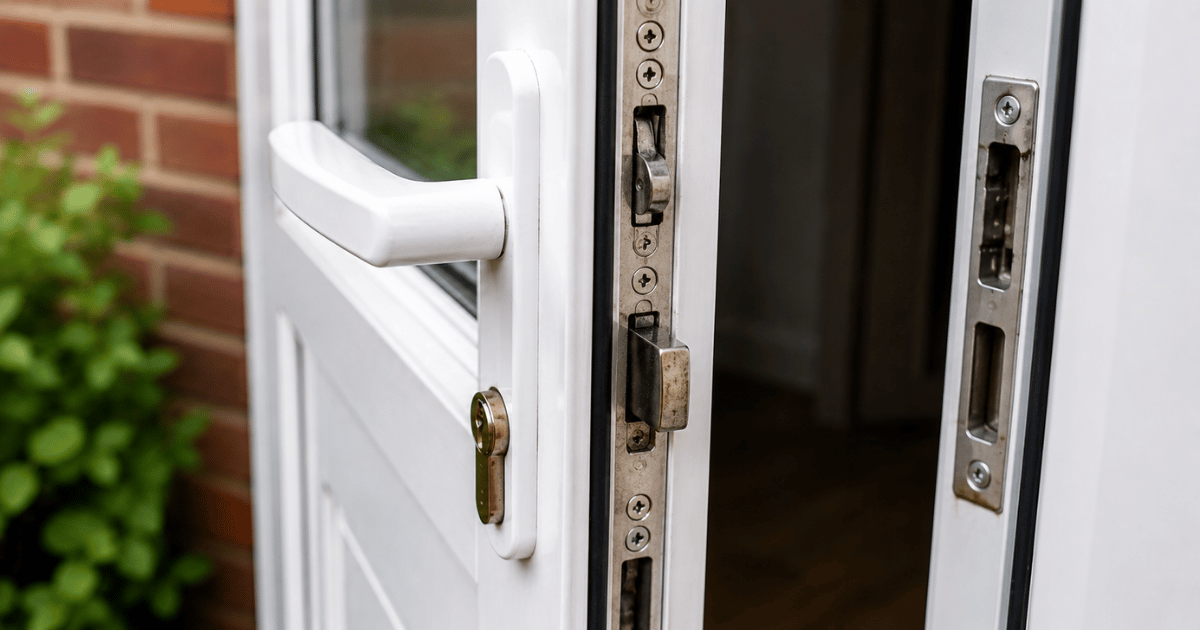
Your key turned smoothly. Now you have to jiggle it, force it, and lean against the door just to get it to lock. Sound familiar? If your UPVC door lock is stiff in Ipswich, you are watching a problem that will only get worse.
A stiff or jammed UPVC door lock is usually caused by dirt buildup, lack of lubrication, a dropped door, a worn multipoint gearbox, a corroded euro cylinder, or seasonal weather expansion. In coastal areas like Ipswich, salt air accelerates corrosion inside the lock, making regular maintenance even more critical.
Here is what most people do wrong. They force it. They slam the door harder. They twist the key with both hands. Every time you do that, you push a £65 repair closer to a £200 gearbox replacement.
At Kingdom Locksmith, our door lock repair services in Ipswich fix stiff and jammed uPVC locks every week. We carry cylinders, gearboxes, and handles in the van. Most repairs take under an hour. No call-out charge.
In this blog, we’ll explain exactly why your UPVC door lock is stiff or jammed in Ipswich, how to diagnose the problem yourself, what you can safely fix at home, and when to call a professional before it gets worse.
Quick Summary: Why Your UPVC Door Lock Is Stiff or Jammed
A UPVC door lock stiff in Ipswich is almost always caused by one of five problems: dirt and dried lubricant clogging the internal mechanism, the door dropping on its hinges and misaligning the bolts, a worn multipoint gearbox creating internal resistance, a corroded or seized euro cylinder, or seasonal temperature changes expanding or contracting the door. Ipswich’s proximity to the Suffolk coast adds an extra factor. Salt-laden air accelerates corrosion inside the lock faster than inland areas. The good news? Every one of these is fixable in a single locksmith visit without replacing the entire door.
Key Takeaways
- Do not force a stiff lock. Every time you do, you risk snapping the gearbox and doubling your repair bill.
- Never use WD-40 on a uPVC door lock. It strips lubrication and attracts dirt, making the problem worse.
- The five most common causes are: dirt buildup, a dropped door, a worn gearbox, a faulty cylinder, and weather expansion.
- You can run three simple tests at home to identify the problem before calling a locksmith.
- Most UPVC door lock repairs in Ipswich cost between £50 and £200, depending on the fault.
- A stiff lock that is ignored will eventually jam completely, leaving you locked out or your home or unsecured.
- In coastal Ipswich, lubricate your locks every 3 months with silicone spray to prevent salt air corrosion.
5 Reasons Your UPVC Door Lock Is Stiff or Jammed in Ipswich
A stiff lock does not happen overnight. It builds. The key gets a little harder to turn each week. The handle needs more force to lift. Then one morning, nothing moves at all.
Understanding why it is happening tells you exactly what needs fixing. Here are the five causes we see most often when Ipswich homeowners call us about a UPVC door lock that is stiff or jammed.
Dirt, Debris, and Lack of Lubrication
This is the most common cause. And the easiest to prevent.
The inside of a euro cylinder contains tiny spring-loaded pins that move every time you insert and turn the key. The multipoint bolt tracks along the edge of the door have hooks, rollers, and latches that slide in and out every time you lift the handle. All of these metal parts need lubrication to move freely.
Over months and years, dust, grit, and pollen work their way into the mechanism. Old lubricant dries out and turns into a sticky paste. The moving parts grind against each other instead of gliding.
Now add Ipswich’s location. The town sits just 12 miles from the Suffolk coast. Salt-laden air blows inland constantly. That salt settles on exposed metal components, particularly around the keyhole and bolt tracks, and accelerates corrosion. The pins inside the cylinder develop a thin layer of oxidation that makes the key feel gritty and resistant.
A silicone-based spray cleans and lubricates simultaneously. A five-minute application can restore a stiff lock to smooth operation if the problem is caught early enough.
Our door lock repair services in Ipswich include professional cleaning, lubrication, and testing of the full locking mechanism. If the damage has gone beyond what lubrication can fix, we diagnose the next step on the spot.
The Door Has Dropped and Bolts Are Catching the Frame
Every uPVC door is heavy. The glass panel, the frame, the reinforcing steel inside the plastic. All of that weight hangs on two or three hinges. Over time, those hinges loosen.
The door drops by a few millimetres. Not enough to notice by eye, but enough to throw the multipoint locking system out of alignment.
When you lift the handle, the bolts try to extend into the keeps (the metal plates in the frame). But the door has shifted, so the bolts hit the edge of the keeps instead of sliding cleanly into the centre. That creates the stiffness you feel in the handle and the resistance when you turn the key.
The symptoms build gradually. First, the handle feels slightly harder to lift. Then you start having to push the door into the frame while lifting the handle. Then you have to push and lift and turn the key all at the same time. Eventually, it jams.
A locksmith resolves this by adjusting the hinge positions, repositioning the keeps, or replacing worn hinges. The multipoint bolts slide cleanly into their targets again, and the stiffness disappears.
Our uPVC door repair in Ipswich covers full hinge adjustment, keep realignment, and door re-hanging for all major uPVC door brands.
The Multipoint Gearbox Is Wearing Out
The gearbox is the metal box behind the handle that converts your lifting motion into the movement of the bolts. Springs push. Cams rotate. Hooks extend. It all happens in sequence, every time you lock the door.
After roughly 7 to 8 years of daily use, those internal parts wear down. Springs weaken. Cam edges round off. The gearbox starts creating resistance where there was none before.
You will feel it as a notchy, gritty sensation when lifting the handle. Like something is catching inside. The stiffness increases over weeks and months. Some days it feels fine, other days the handle barely moves.
This is a warning phase. The gearbox is telling you it is on its way out. If you keep forcing it through the resistance, the remaining teeth will shear off and the gearbox will fail completely. The handle either goes completely floppy or locks solid.
A gearbox replacement is a locksmith job. The handle, cylinder, and faceplate all need removing to access it. The wrong gearbox type or incorrect reassembly leaves the door worse than before.
Our door mechanism repair services in Ipswich cover gearbox diagnosis and same-day replacement. We carry the most common gearbox types in the van, so most jobs are completed in a single visit.
The Euro Cylinder Is Seized or Corroded
The cylinder is the barrel where you insert your key. Inside it, tiny pins align with the cuts on your key to allow the barrel to rotate. When those pins corrode, stick, or wear unevenly, the key becomes difficult to turn.
Corrosion is the biggest enemy. And in Ipswich, with its coastal humidity and salt air exposure, cylinders deteriorate faster than they would in a landlocked city.
The symptoms are distinct. The key goes in but feels like it is grinding against sand. You have to wiggle it to find the right position. Sometimes the key turns halfway then stops dead. Or the key goes in smoothly but refuses to turn at all.
A cylinder that has seized due to corrosion cannot be saved. The internal pins are damaged. The only fix is a replacement.
But here is the positive side. A new cylinder is one of the cheapest and fastest locksmith fixes. It takes 10 to 15 minutes and immediately restores smooth key operation.
Our lock replacement services in Ipswich include removing the old cylinder, fitting a correctly sized replacement, and testing the full multipoint system before we leave.
Hot or Cold Weather Is Expanding or Contracting the Door
uPVC is a plastic material. It responds to temperature changes.
In summer, especially during the heatwaves that have become more frequent in Suffolk, the door panel expands. It presses tightly against the frame, creating friction. The bolts struggle to reach the keeps because the door is sitting further forward than normal. The handle becomes stiff and the key is harder to turn.
In winter, the opposite happens. The door contracts, creating small gaps. The locking points shift position and miss their targets. The handle lifts but the bolts do not fully engage.
South-facing doors in Ipswich take the worst of it. Direct afternoon sun heats the uPVC unevenly, causing one side of the door to expand more than the other. That creates a twist that throws the entire mechanism out of alignment.
If your lock works perfectly in spring and autumn but jams in summer or stiffens in winter, weather is almost certainly the cause.
A locksmith can adjust the keeps and hinges to accommodate the seasonal movement. Some Ipswich homeowners have us adjust the door twice a year, once before summer and once before winter, to keep everything running smoothly.
The First Thing to Do When Your UPVC Door Lock Feels Stiff
Stop forcing it.
That is the most important advice in this entire blog. A stiff lock is a lock that is under stress. Every time you force the handle, force the key, or slam the door to get it to catch, you are pushing the gearbox beyond its limits.
A gearbox that is wearing out can survive for months if you treat it gently. Force it daily and it will snap in weeks. The difference between a £65 adjustment and a £200 mechanism replacement often comes down to whether the homeowner kept forcing the lock or stopped and called a locksmith.
Three things to do immediately.
Stop forcing the handle and key. If it does not move easily, do not make it move by force. Open the door, try the lock with the door open, and see if it operates smoothly without the frame in the way.
Do not slam the door shut. Slamming puts enormous stress on the gearbox, the hinges, and the keeps. Close the door gently, use the handle to latch it, and then lift to lock.
Do not spray WD-40 into the lock. This is a mistake almost everyone makes, and it deserves its own section. Read on.
How to Diagnose a Stiff UPVC Door Lock Yourself (3 Quick Tests)
Before you call a locksmith, spend five minutes running these three checks. They cost nothing, require no tools, and tell you exactly where the problem is. They also save your locksmith time on arrival, which can save you money.
The Open Door Test
Open the door fully. It should not be touching the frame at all.
Now lift the handle and turn the key. Watch the bolts on the edge of the door. Do they extend and retract smoothly?
If they move freely with the door open but the lock is stiff when the door is closed, the problem is alignment. The door or the keeps need adjusting.
If the bolts are stiff even with the door wide open, the problem is internal. The gearbox, the cylinder, or both need attention.
This single test separates alignment problems from mechanism problems. It is the first thing every locksmith checks on arrival.
The Key Comparison Test
Find your spare key. Try it in the lock.
If the spare key turns smoothly but your main key is stiff, the key is the problem. It may be bent, worn down, or have a burr on one of the cuts. A new key costs a few pounds and solves the issue instantly.
If both keys are equally stiff, the cylinder is the problem. The internal pins are corroded or damaged, and the cylinder needs replacing.
This test takes 30 seconds and eliminates one of the simplest causes before you spend money on a locksmith.
The Lubrication Test
Buy a can of silicone-based spray from any hardware shop. Do not use WD-40.
Spray a generous amount into the keyhole. Spray along the bolt tracks on the edge of the door. Spray the latch and the hooks where they extend from the door edge.
Now work the key back and forth 10 to 15 times. Lift the handle and lower it repeatedly. You are distributing the lubricant through the mechanism.
If the stiffness improves noticeably, the problem was lubrication. Repeat monthly to keep it smooth.
If there is no improvement at all, the problem is mechanical. A worn gearbox, misaligned keeps, or a damaged cylinder that lubrication cannot fix.
Can You Fix a Stiff UPVC Door Lock Yourself?
Some fixes are safe for a homeowner. Others will make the problem worse or void your insurance. Here is the honest breakdown.
Safe DIY Fixes for a Stiff UPVC Door Lock
Lubricate with silicone spray. The most effective DIY fix. Spray into the keyhole, onto the bolt tracks, and into the latch. Work the key and handle to distribute. Repeat every 3 months.
Tighten loose hinge screws. Open the door and inspect each hinge. If any screws are loose, tighten them with a Phillips screwdriver. Do not overtighten. Just snug them up until they are firm.
Clean the keeps. The metal keeps in the frame collect dirt, paint overspray, and grit. Wipe them clean with a damp cloth. Make sure nothing is blocking the openings where the bolts enter.
Check the cylinder fixing screw. On the edge of the door, with the door open, you will see a small screw on the lock faceplate. This holds the cylinder in position. If it is too tight, it can compress the cylinder barrel and create stiffness. If it is too loose, the cylinder shifts when you turn the key. The screw should be snug but not forced.
Inspect the key. Look at your key closely. Is it bent? Worn smooth on one side? Cracked? A damaged key creates resistance inside the cylinder. If the spare works fine, replace the damaged key.
When to Call a Locksmith in Ipswich
Gearbox replacement. The gearbox sits inside the door behind the handle. Accessing it requires removing the handle, cylinder, and faceplate. Fitting the wrong type or reassembling incorrectly can leave the door completely inoperable.
Cylinder replacement. A new cylinder must be the exact correct length for the door. Too long and it protrudes, creating a snap attack vulnerability. Too short and the key will not engage the gearbox. A locksmith measures and fits the correct size.
Hinge realignment. uPVC hinges are adjustable, but the adjustments are measured in millimetres. A small error in any direction makes the problem worse instead of better.
Keep repositioning. Moving a keep requires unscrewing it, repositioning it to match the new bolt path, and re-fixing it securely. Incorrect positioning means the bolts do not fully engage, leaving the door partially locked.
One more thing worth knowing. DIY lock work on uPVC doors can invalidate your home insurance. Most policies require that lock repairs and replacements are carried out by a qualified professional using insurance-approved hardware. If something goes wrong after a DIY repair and you make a claim, your insurer can refuse it.
Our door lock repair services in Ipswich are carried out by DBS-checked locksmiths who provide a written invoice with full lock specifications for your insurance records.
Why You Should Never Use WD-40 on a UPVC Door Lock
This comes up in almost every call we take about stiff locks. “I sprayed some WD-40 in it but it did not help.” Sometimes it made things worse.
WD-40 is not a lubricant. It is a solvent and water displacer. The “WD” stands for “Water Displacement.” It was designed to protect metal surfaces from moisture, not to lubricate precision mechanisms.
When you spray WD-40 into a lock, three things happen. First, it strips whatever existing lubrication was inside the mechanism. Second, it evaporates within hours, leaving the metal parts dry and unprotected. Third, the residue it leaves behind is slightly tacky, which attracts dust and dirt. Within a few weeks, you have more gunk inside the lock than you started with.
Use silicone spray or graphite powder instead. Silicone spray repels moisture, does not evaporate quickly, and does not attract dirt. Graphite powder is a dry lubricant that works inside the cylinder without creating any residue at all.
Both are available at any hardware shop in Ipswich for under £5. They last longer, work better, and will not damage your lock.
How Much Does It Cost to Fix a Stiff UPVC Door Lock in Ipswich?
The cost depends on what has gone wrong. A simple lubrication visit is very different from a full gearbox replacement. Here is what to expect.
Typical UPVC Door Lock Repair Costs in Ipswich
| Repair Type | Typical Cost Range (Ipswich, 2026) |
| Lubrication and adjustment service | £50 to £80 |
| Hinge realignment | £50 to £80 |
| Euro cylinder replacement | £60 to £100 |
| Handle replacement | £50 to £80 |
| Gearbox (mechanism) replacement | £120 to £200 |
| Full multipoint lock strip replacement | £180 to £280 |
| Anti-snap cylinder upgrade | £80 to £140 |
These figures are based on published UK locksmith pricing data for 2025/2026. Your actual cost depends on the specific fault, door brand, and parts needed. Always ask for a fixed, upfront quote before any work begins.
At Kingdom Locksmith, we diagnose the fault and give you the full price before we start. No call-out fee. No hidden charges.
Fix It Now or Pay More Later
A stiff lock caught early often needs nothing more than lubrication and a minor adjustment. Cost: £50 to £80.
Leave it for a few more months of forcing, and the gearbox snaps. Cost: £120 to £200 for a full replacement.
Wait even longer and you end up locked out, needing an emergency call-out on a Sunday night. Cost: add another £50 to £100 on top for unsociable hours.
The pattern is clear. The earlier you act, the less you pay.
What Happens If You Ignore a Stiff UPVC Door Lock?
A stiff lock is not a stable condition. It does not stay at the same level of stiffness and plateau. It gets worse. Every day you force it, the damage accelerates.
Here is what happens if you do nothing.
The Lock Jams Completely and You Get Locked Out
The gearbox that was stiff for weeks finally seizes. The bolts lock in the extended position and the door will not open. Or the bolts lock in the retracted position and the door will not secure.
Either way, you are calling an emergency locksmith. The job that would have cost £80 as a scheduled repair now costs £150 to £250 as an emergency call-out, potentially at night or on a weekend.
Our emergency locked out service in Ipswich operates 24/7 for exactly this situation. But we would rather fix your lock before it gets to this point.
The Gearbox Snaps and the Door Won’t Secure
A gearbox under constant strain eventually breaks. The internal teeth shear off. The handle goes completely floppy. The bolts sit in the retracted position, and nothing you do moves them.
Your front door closes but does not lock. At all. Three locking points are doing nothing. Your home is as secure as if the door were standing open.
This is not a hypothetical scenario. We see it regularly across Ipswich and Suffolk. Homeowners who knew the lock was stiff kept forcing it, and then called us in a panic when it failed completely.
Your Home Insurance May Be Invalidated
A front door that does not lock properly fails the security requirements in most UK home insurance policies. Insurers expect all final exit doors to be fitted with working locks that meet British Standard BS3621 or equivalent.
According to the Association of British Insurers, failure to maintain adequate door security can result in a reduced or rejected claim if you are burgled. And according to the Office for National Statistics, around 70% of burglaries in England and Wales involve the offender entering through a door.
A stiff lock that you know about but do not fix is exactly the kind of situation an insurer can use to reduce your payout.
Our high security lock services in Ipswich include upgrading your cylinder to TS007-rated anti-snap hardware that meets insurance requirements and provides the highest level of protection against forced entry.
How to Prevent Your UPVC Door Lock from Getting Stiff
Prevention costs almost nothing. A repair costs £50 to £200. An emergency costs more. The maths speaks for itself.
Lubricate Every 3 Months (Especially in Coastal Areas)
The Master Locksmiths Association recommends lubricating uPVC lock mechanisms every 3 months. In Ipswich, with its proximity to the Suffolk coast and constant exposure to salt-laden air, this schedule is not optional. It is essential.
Use silicone spray. Apply it to the keyhole, the latch, the hooks, and the roller tracks on the edge of the door. Work the key and handle 10 to 15 times after spraying.
Four times a year. Five minutes each time. That is 20 minutes of maintenance per year to avoid hundreds of pounds in repair costs.
Check Hinges and Alignment Twice a Year
Spring and autumn. Open the door, check the hinge screws, tighten anything loose. Close the door and look at the gaps around the frame. If they are uneven, the door is starting to drop.
Catching a dropping door before it damages the gearbox saves significant money. A hinge adjustment is £50 to £80. A gearbox replacement caused by a dropped door is £120 to £200.
Never Force a Stiff Lock
If the handle feels harder to lift than last week, stop. Do not push through the resistance. Lubricate first. If that does not help, call a locksmith.
Forcing a stiff lock is the single fastest way to snap a gearbox. And a snapped gearbox always costs more than the repair that would have prevented it.
Upgrade to Anti-Snap Cylinders
Modern anti-snap cylinders are manufactured to tighter tolerances than standard euro cylinders. The key action is smoother, the internal springs are stronger, and the materials resist corrosion better.
If your cylinder is the original one fitted by the door manufacturer, it is likely a basic unrated euro cylinder. Upgrading to a TS007 3-star anti-snap cylinder improves both security and smooth operation.
Our high security lock services in Ipswich include fitting anti-snap cylinders from trusted UK brands, correctly sized and tested before we leave.
Consider a Smart Lock
A smart lock removes the cylinder from the equation entirely. No key means no corroded pins, no worn barrels, no jammed cylinders. You unlock with a phone app, PIN code, or fingerprint.
For Ipswich homeowners who are tired of dealing with coastal corrosion affecting their cylinder year after year, a smart lock is a permanent solution to a recurring problem.
Our smart lock installation in Ipswich covers supply, fitting, app setup, and a full walkthrough so you know exactly how to use it.
Why Call Kingdom Locksmith for UPVC Door Lock Repairs in Ipswich?
A UPVC door lock stiff in Ipswich needs a locksmith who understands the mechanism, the local climate, and the urgency. Not someone who will take a guess and charge you for the wrong repair.
Here is what you get when you call us:
- uPVC door specialists who work on multipoint locks, gearboxes, cylinders, and hinges every single day.
- Same-day repairs in most cases. We carry the most common parts in the van.
- 24/7 availability. If your lock jams at midnight, we are still answering the phone.
- No call-out charge. You only pay for the work we complete.
- Upfront pricing. We diagnose the fault, explain the fix, and give you the full cost before we start.
- DBS-checked locksmiths with ID and branded vehicles.
- 90-day workmanship guarantee and 12-month warranty on all parts.
- Full coverage across Ipswich and Suffolk, including Felixstowe, Woodbridge, Stowmarket, Hadleigh, and surrounding areas.
We are Kingdom Locksmith. Company Registration 11009355. 200+ five-star Google reviews. Real people, real accountability.
Call us now on 0333 006 9691 or request a free callback and we will ring you back within minutes.
Conclusion
A UPVC door lock stiff or jammed in Ipswich is not something to live with. It is a warning. The lock is telling you that something inside has worn, shifted, corroded, or dried out. And every day you force it is a day closer to complete failure.
The fix is usually simple. Lubrication, a hinge adjustment, a new cylinder, or a gearbox swap. Most repairs take under an hour and cost less than you expect.
Do not wait for the jam. Do not wait for the lockout. Do not wait for the insurance claim that gets rejected because your front door was not locking.
At Kingdom Locksmith, we fix stiff and jammed uPVC locks across Ipswich and Suffolk every week. We arrive fast, carry the parts, and give you an honest, upfront price.
Your door should lock smoothly, every time.
Call us now on 0333 006 9691 for same-day door lock repair services in Ipswich. No call-out charge. 90-day guarantee on every repair.
Frequently Asked Questions
Question: Why is my uPVC door so hard to lock?
Answer: The most common causes are dirt buildup in the lock mechanism, lack of lubrication, a dropped door misaligning the locking points, or a worn gearbox creating internal resistance. In coastal areas like Ipswich, salt air also corrodes internal metal components, accelerating stiffness. Start by lubricating with silicone spray. If that does not help, call a locksmith.
Question: Can I use WD-40 on a uPVC door lock?
Answer: No. WD-40 is a solvent and water displacer, not a long-term lubricant. It strips existing lubrication and then attracts dust and dirt, creating a sticky residue that makes the lock stiffer over time. Use a silicone-based spray or graphite powder instead. These repel moisture and keep the mechanism moving smoothly without causing buildup.
Question: How do I loosen a stiff uPVC door lock?
Answer: Spray silicone lubricant into the keyhole and along the bolt tracks on the edge of the door. Work the key and handle back and forth 10 to 15 times to distribute the lubricant. If the stiffness improves, repeat monthly. If it makes no difference, the problem is mechanical, such as a worn gearbox or misaligned keeps, and needs a professional locksmith.
Question: Why does my uPVC door lock jam in hot weather?
Answer: uPVC expands in heat. Even 1 to 2mm of expansion can push the door against the frame, preventing the multipoint bolts from reaching the keeps. South-facing doors in Ipswich are especially prone to this in summer. A locksmith can adjust the hinges or reposition the keeps to accommodate the seasonal movement.
Question: How much does it cost to fix a jammed uPVC door lock in Ipswich?
Answer: A lubrication and adjustment service typically costs £50 to £80. Cylinder replacement costs £60 to £100. A full gearbox replacement runs £120 to £200. Always ask for an upfront, fixed quote before work begins. Fixing a stiff lock early is significantly cheaper than waiting for it to jam completely and needing an emergency call-out.
Question: Why is my key hard to turn in my uPVC door?
Answer: The euro cylinder may be corroded, worn, or the wrong size for the door. A loose cylinder fixing screw can also cause the barrel to shift when you turn the key, creating resistance. Try your spare key first. If both keys are stiff, the cylinder needs replacing. If only one key is stiff, that key is likely bent or worn and needs a new cut.
Question: Should I repair or replace a stiff uPVC door lock?
Answer: Repair is almost always the right choice. Most stiff lock problems are caused by specific components like the cylinder, gearbox, keeps, or hinges that can be fixed or swapped individually. Full door replacement costs £300 to £800 or more, while most lock repairs are under £200. Only replace the door if the panel itself is cracked, severely warped, or structurally failing.