Composite Door Lock Problems: A Diagnostic Guide

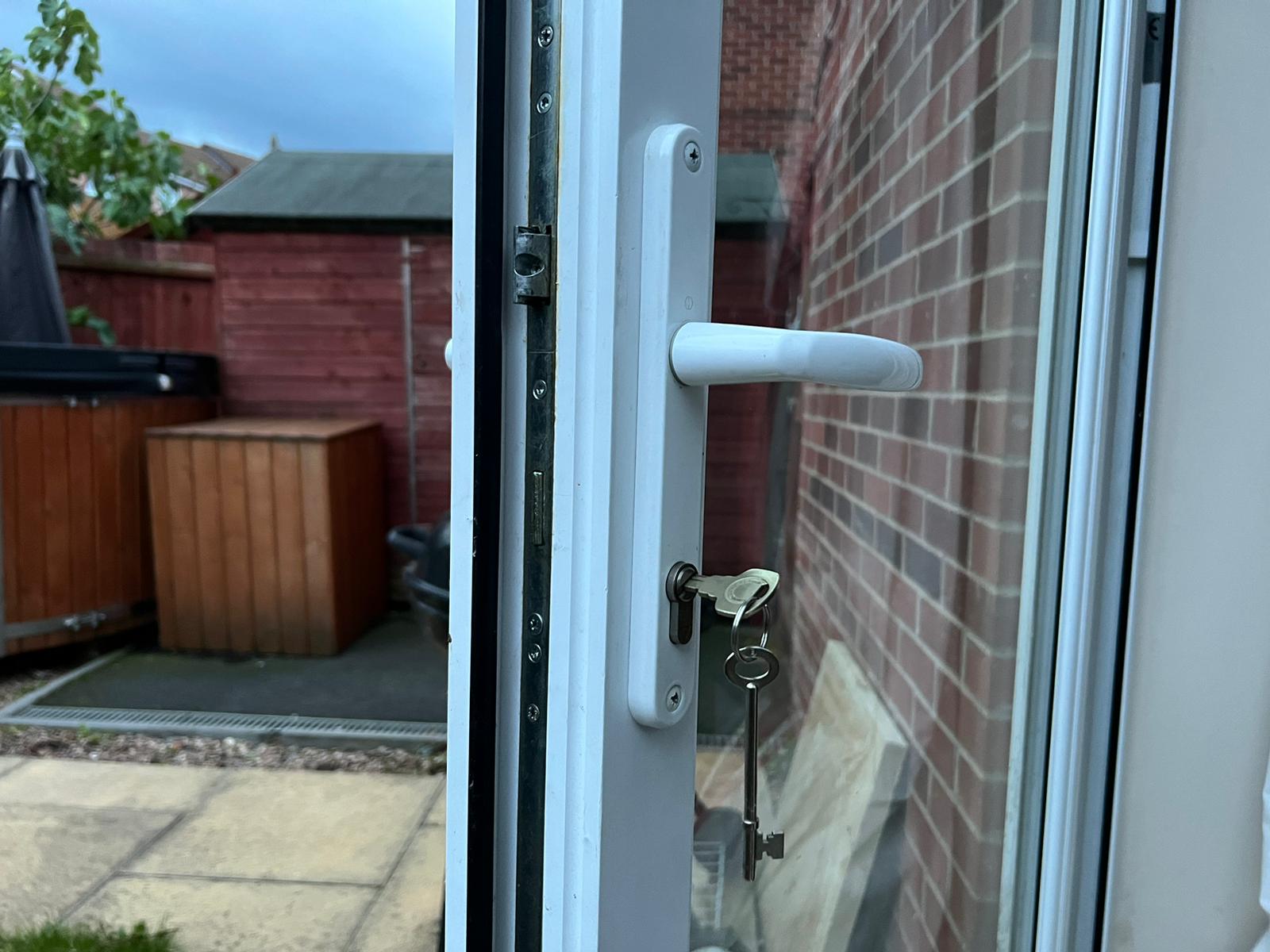
Composite doors are secure, but their locking system is a chain of connected parts: handles, spindle, cylinder, a central gearbox, the multipoint strip along the door edge, and the keeps in the frame. When one part struggles, the symptom often shows up somewhere else, so it pays to diagnose before replacing anything.
This guide comes from what we see on real jobs. The short version: on composite, uPVC and patio doors alike, the part that fails most often is the gearbox, and the usual reason it fails is a door that has dropped or moved out of line.
How a composite door lock works
Most composite front doors use a multipoint lock. Lifting the handle throws hooks, bolts or rollers along the door edge into keeps in the frame, and turning the key locks them there. The gearbox in the middle of the strip, behind the handle, turns that handle and key movement into movement along the whole strip. ERA's guide to multi-point door locks and the Master Locksmiths Association's door lock types guide show the parts.
Because the parts work together, the part that feels wrong is not always the part that has failed. A stiff key does not prove the cylinder is worn, and a stiff handle does not prove the gearbox is broken.
Why composite door locks fail: usually the door, not the lock
Most of the gearbox failures we repair start the same way. The door drops on its hinges, moves out of line, or swells in hot weather, because composite and uPVC doors do expand with heat. The hooks and bolts start rubbing on the keeps instead of sliding into them, so the handle gets harder and harder to lift.
Most people put up with it and lift the handle with force. That works for a few months. But every forced lift strains the gearbox, and eventually something inside it breaks. It rarely breaks at a convenient time: it tends to be late at night, or first thing in the morning when you need to leave and cannot lock the door.
The difference in cost is real. On our pricing page, taken from our own recorded jobs, a door alignment and adjustment is typically £84, while lock repairs, which include gearbox and mechanism replacements, are typically £192, both including VAT. An adjustment can be booked when it suits you; a broken gearbox usually cannot wait.
Start with the door open and closed test
This is the most useful check you can do yourself.
- With the door open, lift the handle and turn the key gently, and watch the hooks, bolts or rollers on the door edge.
- Close the door and do the same, without forcing anything.
If everything is smooth with the door open but stiff when it is closed, the door and frame are pushing against the locking points. That points to alignment, hinges or keeps, not a broken lock. Yale's guidance for its AutoEngage multipoint lock also stresses correct alignment of door, frame and keeps.
If it is still stiff with the door open, the problem is inside the lock hardware: the handle, spindle, cylinder, gearbox or strip.
Common symptoms and what they usually mean
The handle is hard to lift, but only when the door is shut
This is the classic early warning. The lock is usually fine for now, but the door needs adjusting before the gearbox pays the price. Stop forcing it and get the door looked at. Our guide on how to adjust a uPVC door locking mechanism explains what adjustment involves.
The handle is floppy or droops
A drooping handle is a different fault from a stiff one. It is often the spring inside the handle, the spindle, or the fixings, but it can be the gearbox. If the handle droops but still pulls the latch back and throws the hooks, the fault may be in the handle alone. If the hooks no longer respond, it is further in. Our door lock repair service covers handles and cylinders.
The handle moves but the hooks or bolts do not
The spindle carries the handle's movement into the gearbox. If the handle moves but nothing moves along the door edge, the spindle connection or the gearbox has usually failed. Stop working the handle, because repeated attempts can make the opening harder.
The key will not turn
Try a spare key first, because a worn key can be the whole problem. With the door open, check whether the key turns normally. If several keys are stiff even with the door open, the cylinder or the mechanism behind it needs inspecting. If the key turns freely with the door open but not closed, it is alignment again. Never force a stiff key: a snapped key adds a second problem.
The key turns, but the door will not lock or open
A key can turn while another part of the system fails. We have separate guides for these two symptoms: when the lock turns but will not lock the door, and when the key turns but the door will not open.
One hook or bolt does not engage
Watch that locking point with the door open. If it moves with the others but misses its keep when the door closes, it is alignment or a keep that needs adjusting. If it does not move at all, the strip itself needs attention.
Locked shut, and the key just spins
This is one of the rarer failures, but it is the one people remember. You locked the door as normal. Now, when you turn the key to open it, the cylinder spins round and round, nothing moves, and the handle is stiff and will not go down.
On a common mechanism such as a Millenco, there are two typical breaking points inside the gearbox. One is at the handle, where the latch connects. The other is the bolt thrower, a small part that sits just above the cylinder's cam and moves the bolt when you turn the key. After years of use, often years of forcing a misaligned door, the thrower can split in half. You can still lock the door, but the key can no longer pull the bolt back.
Opening a door in that state takes skill rather than force. Every mechanism has its own tricks. Often it means taking the handles off and making a small, precise hole beneath the handle position, where it is hidden once the handles go back on. Done properly, you will never see it. Sometimes it feels more like surgery than locksmithing.
Gearbox or the whole mechanism?
Most failed composite door locks are fixed by replacing the gearbox alone, which is quicker and cheaper than a full strip. Some mechanisms have the gearbox built into the strip as one unit, and some older gearboxes are no longer made. In those cases the whole mechanism is replaced. The replacement must match the existing one (backset, centres, faceplate and locking-point layout), not just look similar. Our door mechanism and gearbox repair page explains what we replace and when.
The complete door very rarely needs replacing because one locking part has failed. For the wider decision, see our guide to lock repair versus replacement.
Fixing the cause, not just the part
A broken gearbox is usually a symptom. If we replace it and leave the door dropped, the new one will go the same way. So after the lock is working again, we find the root cause and adjust the door so it closes and locks freely.
Doors keep moving over the years. If yours starts to drop again, or the handle is getting stiff, book an adjustment then. It costs far less than a new gearbox, and you will not need an emergency locksmith at the worst possible moment. Our mechanism maintenance guide covers the simple checks worth doing once a year.
When to stop and call a locksmith
Stop if the handle needs real force, the mechanism grinds or crunches, a locking point stops moving, the key feels close to bending, or the door will no longer lock reliably. Do not take the gearbox apart or adjust several keeps at once: changing several things together hides the original cause.
Frequently asked questions
Why is my composite door suddenly hard to lock?
Usually because the door has moved: dropped on its hinges, shifted in the frame, or expanded in the heat. Try the open and closed test. If it is fine open and stiff closed, the door needs adjusting.
Why do I have to lift my composite door to lock it?
Because the hooks and bolts are no longer meeting their keeps cleanly. It works for a while, but forcing it strains the gearbox, which is the most common part we replace. An adjustment now costs far less.
Does a stiff handle mean the gearbox is broken?
Not necessarily. Alignment, keep pressure and handle parts can all make a handle stiff. If it is stiff even with the door open, a hardware or mechanism fault becomes more likely.
Can a composite door gearbox be replaced without replacing the door?
Yes. In most cases we replace the gearbox alone. If the gearbox is built into the strip or is no longer made, we replace the whole mechanism. The door itself stays.
My key spins and the door will not open. What has happened?
Most likely a part inside the gearbox, often the bolt thrower, has broken, so turning the key no longer moves the bolt. Stop turning it and call a locksmith. It can be opened, usually with only a small hole that is hidden under the handle.